
What Is Scalability?
19 Oct 2003There is an interesting article on ONJava.com entitled The PHP Scalability Myth. The author describes scalability as follows:
There are a number of different aspects of scalability. It always starts with performance, which is what we will cover in this article. But it also covers issues such as code maintainability, fault tolerance, and the availability of programming staff.
Is this what scalability means? It's certainly not my definition. Do code maintainability, fault tolerance, and the availability of programming staff have something to do with scalability? They can if your definition of scalability takes human resources into account, which seems reasonable.
The definition I find on Dictionary.com describes scalability as:
How well a solution to some problem will work when the size of the problem increases.
This seems like a better definition. A textbook definition would be something to the effect of, "the ability to scale." This is probably a starting point that everyone can agree to. So why do some people argue that certain technologies (PHP, mod_perl, Java, etc.) don't scale? I have always assumed that these people define scalability as the ability for something to scale well and that they're using their own subjective opinions to define what scales well and what doesn't. This is where things go wrong. It also seems that more and more people use scalability as a measure of performance, when this is not the case either. Something that performs very poorly can still potentially scale very well. Scalability is a relative measurement.
Before I say more, I should describe what I think it means for something to scale well. Consider the following three figures:
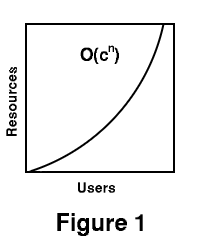
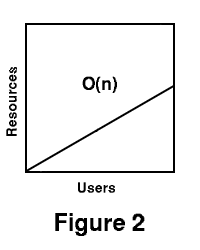
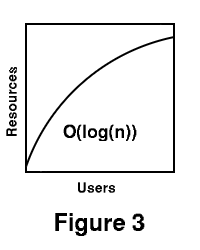
Figure 1 represents a case where the amount of required resources grows exponentially compared to the number of users. This is bad. In Figure 2, the amount of required resources grows linearly. This is typical (the rate of growth can vary; smaller is better). In Figure 3, the amount of required resources grows logarithmically. This is very nice. My opinion is that both Figure 2 and Figure 3 represent something that scales well. Because I am a Web developer, a growing number of users is typically when the "size of the problem increases" for me. The term "resources" refers to many things, but most people are concerned with cost. Things that cost money include hardware, software, human resources, and time.
Lastly, let's look at an example. Consider two hypothetical technologies, Technology A and Technology B:
Resources required to build an application that supports 100,000 users a day:
Technology A: 10 servers, 5 developers, and 6 months of development time
Technology B: 40 servers, 10 developers, and 3 months of development time
Resources required to build an application that supports 250,000 users a day:
Technology A: 25 servers, 5 developers, and 9 months of development time
Technology B: 50 servers, 10 developers, and 6 months of development
Which technology do you think scales better? Which appears to be the better choice when no more than 250,000 users a day need to be supported? Should things like maintainability and robustness be taken into consideration? How do you measure these things? If you are making decisions based on your assumptions about the scalability of certain technologies without asking these types of questions, you need to stop making such decisions.